
Arduino® VENTUNO™ Q: Dual-Brain Platform for Robotics
Rapid Prototyping with AI Computing Power and Real-Time Control
Demanding robotics, drone, and Edge AI applications require both powerful computing capabilities and precise real-time control. The Arduino VENTUNO Q board combines both in a highly integrated, open-source platform: LLMs, VLMs, computer vision, real-time actuation, and control are combined with a comprehensive software stack, development tools, and a broad ecosystem of accessories. This enables even complex applications to be prototyped and developed quickly.
SamplesWhy is the VENTUNO Q Well Suited for Demanding Robotics and Edge AI Applications?
The dual-brain architecture combines powerful AI and computer vision processing with deterministic real-time control. This allows different requirements to be handled on a single development platform.
At the heart of the VENTUNO Q is a dual-brain architecture: the Qualcomm Dragonwing™ IQ8 Platform with the Qualcomm® Hexagon™ NPU that delivers 40 dense TOPS, handles robotics, computer vision, and Edge AI tasks under Ubuntu or Debian Linux, while the STM32H5F5 running Zephyr manages deterministic real-time control, actuation, and safety-critical functions.
A messaging interface with a Remote Procedure Call (RPC) protocol developed by Arduino connects both subsystems. This allows Linux applications and the real-time environment to communicate with each other, while compute-intensive AI processes can run independently of time-critical control tasks.
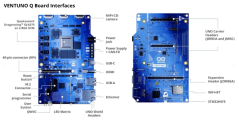
Overview of VENTUNO Q Interfaces and Features
- NPU: Hexagon Tensor AI Processor
Up to 40 dense TOPS for local machine learning inference - CPU: Dragonwing IQ-8275 SoC (Dragonwing IQ8 Series)
8-core Qualcomm® Kryo™ CPU (2x Prime @ 2.35GHz, 2x Gold @ 2.1GHz, 4x Silver @ 1.95GHz) (runs Ubuntu or upstream Debian Linux) - GPU: Qualcomm® Adreno™ 623 GPU @ 877MHz
Supports hardware video encoding/decoding and display pipelines - ISP: Qualcomm Spectra™ 692 ISP
Supports multi-camera image processing - RT MCU: STM32H5F5 microcontroller
Arm Cortex-M33@250MHz, 4MB flash, 1.5MB RAM (runs the Arduino core on Zephyr OS) - Memory: RAM & internal storage
16GB LPDDR5 RAM and 64GB eMMC onboard storage - Expansion Storage: M.2 NVMe slot
Supports Gen 4 external high-speed storage - Wired Network Interface: Ethernet
1x 2.5Gbit RJ45 Ethernet port - USB & Video: Ports & display:
1x USB-C (with DP Alt mode/video output/role switching), 2x USB 3.0 Type-A - Camera Interface: MIPI-CSI
3x MIPI-CSI camera connectors for multi-angle computer vision - Industrial Interface: CAN-FD:
Includes CAN-FD physical-layer connections on terminal blocks and expansion headers - Power Supply: Options
USB-C (5V @ 3A max), 5.5x2.1 mm barrel jack (12–24VDC), or screw terminal (7–24VDC) - Software: Arduino App Lab, compatible with ROS 2 and other Linux tools
Prototyping & Use Cases
Hardware, software, development tools, interfaces, and accessories are combined in a single platform, supporting the rapid implementation and evaluation of robotics, drone, and Edge AI concepts.
VENTUNO Q comes with a rich set of pre-built sample applications and other software resources that significantly simplify the task of prototyping advanced Robotics and Edge AI concepts. Within the Arduino App Lab an engineer can leverage some or all of the resources listed below and/or customise them for their own purposes:
Sample Applications: Curated no-code sample applications, including:
- Computer vision and tracking
- Generative and multimodal AI
- Robotics and motion control
- Industrial sensing and maintenance
Bricks: Pre-built, reusable code blocks that can be “snapped” together in Arduino App Lab. Categories include:
- Robotics and control
- AI & machine learning
- Interface and UI
- Hardware and sensors
Sketches: Real-time control resources for the STM32 MCU, including:
- Standard libraries for controlling sensors
- Hardware peripheral control for high-speed, jitter-free PWM and GPIO
- Industrial protocols such as CAN FD
- RPC communication handlers simplify inter-process communication
- Shields and drivers for UNO shields / Arduino® Modulino™ and Raspberry Pi HATs
AI Models: Ready-to-run models, including:
- YOLO-X / Posenet / MobileNet / EfficientNet
- Text-based LLM, like Gemma 4, Qwen 2.5/5
- VLMs such as Qwen VLM
- Voice assistants, including Whisper and Melo TTS
Autonomous Navigation: The Nav2 and SLAM toolkits can be run in the ROS2 environment integrated directly into the VENTUNO Q Linux subsystem. The robotics bricks make it easy to get started quickly.
Learn more about Single Board Computers.
Your Contract Person
If you are looking for a single unified and rapid prototyping platform for Robotics and Edge AI applications that already bridges the gaps between Advanced AI and real time sensing, motion control and actuation, please refer to Thomas Carmody.