
KDS: More Precise Timing for High-Speed Communication
Frequency Stability
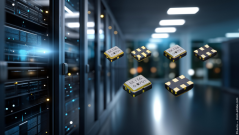
Data communication is experiencing rapid growth, further accelerated by the use of AI. Optical network standards are evolving from 400G to 800G, while 1.6T is becoming increasingly realistic. At the same time, internal server interfaces are also advancing to PCIe Gen 6.0. For high-speed communication systems, differential crystal oscillators (DCXOs) are indispensable. They provide high frequencies, ultra-high precision, extremely low jitter, and strong noise immunity. KDS offers suitable products that meet these demanding requirements.
Requirements for Differential Oscillators
Due to this modulation scheme, crystal oscillators with differential output are required, with the following characteristics being particularly important:
- High noise immunity: To maintain signal quality in PAM4 modulation
- Extremely low jitter: For stable and reliable data transmission
- High frequency: To suppress interference caused by frequency multiplication and to optimize transmission efficiency
- Low frequency deviation: To enable lossless transmission of large data volumes and ensure perfect synchronization between transceivers
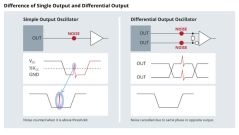
Differential-output oscillators are primarily used to increase noise immunity. They simultaneously provide two signals with a 180-degree phase difference (non-inverted and inverted outputs). Conventional single-ended oscillators generate only one output signal.
Noise Immunity Through Differential Signaling
When external interference occurs, it is directly superimposed on the signal, which can lead to noise, synchronization errors, and degraded communication quality – an especially critical disadvantage in high-speed data transmission. Differential-output oscillators operate differently (see figure 1): they use the difference between the two opposite-phase signals, which effectively cancels out external noise that appears equally on both lines (common-mode noise). As a result, the IC can receive the signal from the oscillator stably and without distortion, even in environments with significant electrical interference.
Growing Data Traffic Drives Innovation
According to forecasts, global data traffic is expected to increase by about 30 times by 2030 and by as much as 4,000 times by 2050. This trend is significantly driving the further development of optical transceivers and PCIe interfaces in servers. These communication standards use the PAM4 modulation scheme. While PAM4 is already well established in optical transceivers, starting with PCIe version 6.0 this modulation will also become common in high-speed server communication. As data rates continue to rise, the requirements for precise timing devices are increasing as well.
The Impact of Jitter
Noise does not originate only from external sources. The clock signal generated by a crystal oscillator is always multiplied in the receiving IC. However, the more frequently this multiplication occurs within the PLL, the more the timing noise of the signal – its jitter characteristics – deteriorates. Reducing the multiplication factor, on the other hand, significantly improves jitter performance.
Moving Toward Higher Frequencies
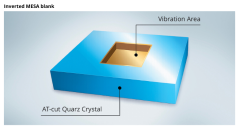
For a long time, the maximum achievable frequency of crystal oscillators was a limiting factor. In recent years, however, the development of frequencies above 100MHz has advanced through the use of reverse-MESA crystal blanks (see figure 2). To minimize the noise amplification caused by multiplication within the IC, the industry is now increasingly shifting from the conventional 100MHz to 156MHz band toward higher frequencies.
Quartz vs. MEMS Oscillators
Among the key characteristics required for timing devices in high-speed communication, the jitter performance of the signal generated by the timing device is probably the most important. Jitter directly leads to communication errors. In this respect, crystal oscillators outperform MEMS oscillators. Although MEMS technology has made remarkable progress in recent years, MEMS oscillators internally multiply frequencies using oscillation ICs, which results in higher jitter levels. In contrast, the naturally high Q factor of quartz enables significantly more stable and precise signals.
New KDS Differential Output Oscillators
To meet these requirements, KDS has announced the DS and DE differential-output oscillator series, both of which feature improved jitter performance. In the future, the DS series will cover standard applications, while the DE series will target the high-performance segment. The DS series is specifically designed for the widely used 156.25MHz frequency. Its frequency stability of ±50 ppm within a temperature range of –40 to +105°C meets the industry standard. However, the jitter performance has been significantly improved: while the established DSO223SK with LV-PECL output in a 2520 package achieves a typical jitter value of 90fs, the DS2520AK achieves a typical value of only 32fs, setting a new benchmark in its class.
DE Series for Higher Performance
The DE series goes a step further and extends the capabilities of the DS series in two key areas. First, it offers an even lower frequency deviation of ±20 ppm over the temperature range of –40 to +105°C. Second, it maintains this high stability even at double the frequency of 312.5MHz. In direct comparison with the DS series, the jitter performance of the DE series is slightly lower when adjusted for the respective frequency ratio, but it still remains at a similarly high level of performance. For example, compared with the previously mentioned DS2520AK at 156.25MHz, which has a typical jitter value of 32fs, the DE2520AK at 156.25MHz achieves a typical value of 35fs.
Roadmap to 1.3GHz
The development of the DE series to support 312.5MHz signals illustrates a broader trend toward even higher frequencies in crystal oscillators. In fact, KDS aims to develop oscillators capable of reaching 625MHz – twice 312.5MHz – and even 1.3GHz – four times that frequency – by around 2027 or 2028. Crystal oscillators that struggled to reach 125MHz just a generation ago now appear ready to enter this higher frequency range, thanks to the introduction of inverted MESA crystal blanks.
Key Features of the DS Series
- Available frequencies: 100MHz, 125MHz, and 156.25MHz
- Frequency deviation: ±50ppm (–40 to +105°C)
- LV-PECL output oscillators: DS2016AK (2.0×1.6mm) and DS2520AK (2.5×2.0mm)
- LVDS output oscillators: DS2016AJ (2.0×1.6mm) and DS2520AJ (2.5×2.0mm)
- HCSL output oscillators: DS2016AD (2.0×1.6mm) and DS2520AD (2.5×2.0mm)
- Supply voltage: LVDS +1.8V, +2.5V, +3.3V
- Samples are already available.
- Mass production will start in June 2026.
Key Features of the DE Series
- Available frequencies: 100MHz, 125MHz, 156.25MHz, and 312.5MHz
- Frequency deviation: ±20ppm (–40 to +105°C)
- LV-PECL output oscillators: DE2016AK (2.0×1.6mm) and DE2520AK (2.5×2.0mm)
- LVDS output oscillators: DE2016AJ (2.0×1.6mm) and DE2520AJ (2.5×2.0mm)
- HCSL output oscillators: Coming soon
- Samples are already available.
- Mass production will start in August 2026.
Future Frequencies: 625MHz/1.3GHz
Unique Features of the DE and DS Series: Arkh.3G and Arkh.2G
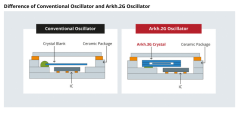
The DS and DE series are based on KDS’s oscillator architecture “Arkh.2G”. While it has the same structure as a conventional crystal oscillator, it uses a pre-assembled crystal resonator made from three crystal wafers, referred to as “Arkh.3G”, instead of a single crystal blank. This approach offers three key advantages (figure 3):
- Increased shock resistance due to the robust multi-disk construction
- Significantly lower field failure rates
- Easier scaling of production capacity thanks to the reduced space requirements for oscillator manufacturing processes and equipment
Improved Reliability
Using a pre-assembled crystal oscillator as the oscillation source can significantly increase shock resistance and drastically reduce failure rates in the field. The crystal blank is doubly encapsulated, making it more resilient to external shocks than conventional crystal oscillators. Even with the introduction of reverse-MESA blanks, which enable higher frequencies, the vibrating element remains a thin crystal blank – a structure that is particularly advantageous at higher frequencies. Moreover, using a pre-tested, fully assembled oscillator ensures a much lower failure rate after device installation compared to solutions that use only raw crystal blanks. A large portion of crystal failures is caused by foreign particles adhering to the crystal blank. Even if contaminants accidentally enter the oscillator during assembly, a pre-tested oscillator as the source remains completely unaffected.
Manufacturing Efficiency
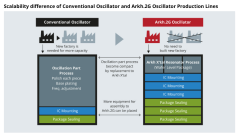
Today, space efficiency in the oscillator manufacturing process is a critical factor. In a typical crystal oscillator production flow, the crystal blank processing stage occupies the largest portion of floor space. This is because each crystal blank must be cleaned, washed, equipped with electrodes, and frequency-trimmed, with each step requiring large specialized equipment. Additional space is also needed for oscillator IC assembly, final product assembly, testing, and packaging. To significantly increase current mass production volumes, building an entirely new factory might be required – an option with enormous costs.
Scalable Production Capacity
With wafer-based crystal oscillators like Arkh.3G, however, the entire oscillator source manufacturing process can be completed in a single production facility. This frees up space for additional assembly and packaging processes, allowing for more efficient scaling of production (see figure 4). Major crystal manufacturers are currently operating at full capacity, while demand for crystal oscillators continues to rise. Over the past ten years, crystal oscillators have always been the first to be affected whenever adjustments to crystal component production capacity were needed. This makes the Arkh.2G structure the optimal strategy to meet the expected significant increase in demand for differential-output oscillators. By using the Arkh.3G structure for the DS and DE series, ultra-miniaturization to sizes such as 1.0×0.8mm will also be possible in the future. Wafer-type crystal resonators with the Arkh.3G structure become full crystal oscillators once an IC is mounted.
The Potential of Differential-Output Oscillators
The adoption of AI is remarkable. Currently, many AI systems, such as Large Language Models (LLMs), are often operated by a few high-performance AI server hubs. However, with the rise of Edge AI, these functions are increasingly distributed across numerous smaller, local hubs. This shift offers benefits such as higher processing capacity, better scalability, lower energy consumption through decentralization, and improved data privacy.
Outlook
In the future, a variety of electronic devices supporting Edge AI are likely to enter the market. To achieve fast communication for the massive amounts of data generated by these devices, precise timing devices are required. Consequently, the demand for differential-output oscillators is expected to increase in Europe as well. KDS is ready to actively support this development, both technically and strategically.
Your Contact Person
If you require ultra-compact oscillators, contact Yasunobu Ikuno.