
New Crystal Oscillators for 156.25MHz and 312.5MHz Applications
High-Speed Communication Needs Better Timing
Data traffic is growing rapidly, accelerated by AI-based applications. Optical standards are evolving from 400G to 800G, with 1.6T already on the horizon, while PCIe is moving to Gen 6.0. These developments place significantly higher demands on timing devices. High-speed systems with PAM4 require oscillators with high frequency, ultra-low jitter, and tight frequency stability. Daishinku Corporation (KDS) addresses these requirements with its new differential series, DS and DE.
DS Series: New Standard for Mainstream Frequencies
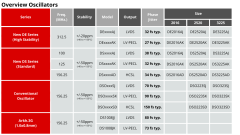
The DS series targets widely used frequencies such as 156.25 MHz and offers significantly improved jitter performance. Compared to previous solutions (90fs typical), the new DS2520AK achieves 32fs typical jitter, enabling higher signal integrity in high-speed communication systems.
Key Features of the DS Series
- Frequencies: 100MHz, 125MHz, 156.25MHz
- Frequency deviation: ±50 ppm (-40°C to +105°C)
- Outputs: LV-PECL, LVDS, HCSL
- Packages: 2.0×1.6mm and 2.5×2.0mm
- Samples are available / Mass production from June 2026
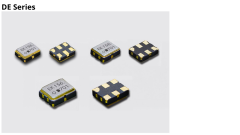
DE Series: Higher Precision and 312.5MHz Support
The DE series expands performance with tighter frequency stability (±20 ppm) and support for higher frequencies up to 312.5MHz, making it ideal for next-generation high-speed interfaces.
Key Features of the DE Series
- Frequencies: 100 MHz, 125MHz, 156.25MHz, 312.5MHz
- Frequency deviation: ±20 ppm (-40°C to +105°C)
- Outputs: LV-PECL and LVDS (HCSL coming soon)
- Packages: 2.0×1.6mm and 2.5×2.0mm
- Samples are available / Mass production from August 2026
Why are Ultra-Low Jitter Crystal Oscillators Critical for High-Speed Communication such as PAM4, 800G Optics, or PCIe Gen6?
Modern high-speed interfaces such as 800G optical networking, upcoming 1.6T systems, and PCIe Gen6 often use PAM4 modulation to increase data throughput. However, PAM4 significantly increases the sensitivity of the signal to timing inaccuracies.
For timing devices, the most critical parameter is therefore jitter. Even small jitter deviations can cause bit errors, data loss, or synchronization issues between transceivers.
Due to their inherently high Q-factor, quartz-based oscillators achieve significantly lower jitter than MEMS oscillators, which typically rely on internal frequency multiplication. As a result, low-jitter crystal oscillators are a key component for next-generation high-speed networks, data centers, and AI infrastructure.
Oscillator Architecture
Both series are based on KDS’ Arkh.2G oscillator architecture, which uses a stacked crystal structure (“Arkh.3G”). This design improves shock resistance, reliability, and manufacturing scalability, while enabling ultra-miniaturized oscillators down to 1.0 × 0.8 mm.
Differential Output Crystal Oscillators Provide Several Advantages
- Ultra-low jitter for stable high-speed signals
- High frequencies such as 156.25MHz and 312.5MHz, commonly used in networking and SerDes architectures
- High noise immunity required for PAM4 modulation
- Precise frequency stability for accurate system synchronization
Your Contact Person
If you require ultra-compact oscillators, please contact Yasunobu Ikuno.