
Next-Generation Prototyping with Arduino UNO™ Q

Securing a Rapid Prototyping Platform
Qualcomm Technologies, Inc. acquires Arduino to promote their Dragonwing™ Edge AI SoCs to a vast IoT ecosystem and to secure a rapid prototyping platform for Edge AI applications.
In October 2025 Qualcomm Technologies, Inc. announced that they had acquired Arduino, the world renowned Italian tech company. It was another significant step for Qualcomm in becoming a leading provider to the internet of things market, and a huge leap for Arduino in terms of resources it can now leverage to offer its users more powerful tools.
SamplesStrong Reputation as a Technology Enabler
Over more than 20 years, Arduino has built a strong reputation as a technology enabler for a massive community of over 33 million users. Its value proposition is to make complex electronics accessible to hobbyists, makers, educators and companies via open-source hardware and software designs. Arduino MCU and sensor boards are also broadly adopted by engineers for prototyping concepts before committing their ideas to mass production.
Possibility to Launch Innovative Edge AI Solutions
By onboarding Arduino into the Qualcomm organization, the footprint of potential users for Qualcomm Dragonwing™ SoCs and enabling technologies increases. Additionally, as the demand for Edge AI increases, Qualcomm now has the possibility to launch innovative Edge AI solutions based on the accessible Arduino development environment to complement Arduino’s portfolio. Arduino will continue to enable the IoT community with their MCU and sensor solutions leveraging the semiconductor vendors they used in the past. Additionally, their commitment to the open-source community remains.
First Example of the New Strategy
Qualcomm Technologies, Inc. will, however, complement the traditional Arduino IoT solutions with a new category of products that deliver advanced use cases such as multi-camera computer vision, edge AI and high-performance compute together with real-time sensing and actuation. Qualcomm recognizes the trend for AI inference at the edge in the industrial market and will use this new portfolio of Arduino platforms based on their technologies to get early traction. When the acquisition was announced, a first example of this new strategy for the Edge AI category was unveiled: the Arduino UNO™ Q.
Arduino UNO™ Q Dual-Brain Board
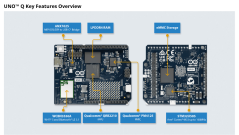
UNO™ Q is the first project that brings the best of Arduino together with the strengths of Qualcomm Dragonwing™ processors in a unique dual-brain architecture. The board is based on the combination of the Qualcomm Dragonwing™ QRB2210 microprocessor, a highly integrated system-on-chip that combines 64-bit quad-core compute running Debian Linux together with an integrated dual-camera ISP and a small AI DSP for Edge AI applications, and separately a 32-bit real-time system based on the STM32U585 running Arduino sketches over Zephyr OS.
Dedicated Remote Procedure Call Mechanism
The QRB2210 delivers high performance compute, camera and Edge AI use cases, while the STM32 responds in real time to inputs from sensors. Both communicate via a dedicated remote procedure call mechanism (RPC). UNO™ Q comes pre-certified (CE/FCC/UKCA) and is built to meet the requirements of the new EU Cyber Resilience Act (CSA) rules, making it an ideal solution to use as it is for prototypes or small quantity production runs.
The innovative UNO™ Q hardware approach is accessible using Arduino’s traditionally intuitive and easy-to-use software interface and development tools. That being said, Arduino had to build new tools specifically for the UNO™ Q.
UNO™ Q Setup
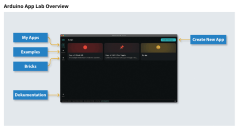
With UNO™ Q in your hands, it is a process to set it up and start development. The UNO™ Q landing page is rich with setup instructions and troubleshooting guides for the hardware and software environment. UNO™ Q can be controlled by the innovative Arduino App Lab. While the traditional Arduino IDE is designed for writing code for a single microcontroller, App Lab is designed to orchestrate apps that run across the dual-brain architecture of UNO™ Q, managing both the high-level Linux/Python side for the QRB2210 SoC and the low-level real-time C++ side for the STM32 simultaneously, as well as the communications between both subsystems.
Arduino App Lab Features
- Dual-Editor Interface: side-by-side editors for C++ (Sketches) and Python. This allows to write the code that controls a motor with C++ to run on the STM32 next to the code that runs an AI vision model or a web dashboard with Python on the QRB2210.
- The »Bridge« Service: It uses a built-in Remote Procedure Call (RPC) system that lets the Linux »brain« and the microcontroller »brain« talk to each other. You can trigger a Python function from a C++ command and vice-versa with little setup.
- Arduino »Bricks«: To speed up prototyping of design concepts, App Lab uses modular code blocks called Bricks. These are pre-packaged AI and functional modules (e.g., an »Object Detection« brick) that can be dragged into a project to give the board high-level capabilities.
- On-Device Development: Unlike the classic IDE where you compile on your PC and »upload,« App Lab can run directly on the board itself. Since UNO™ Q is a full Linux computer, you can plug in a monitor and keyboard and code directly on the hardware in standalone mode (the 4GB RAM variant is for this setup).
New Opportunities to Develop IoT Solutions
UNO™ Q and future Arduino Edge AI solutions – such as the newly launched Arduino VENTUNO™ Q – create new opportunities to develop low-cost IoT solutions that take the Arduino pre-certified, open platforms and incorporate them into a wider system that leverages real-time sensing and control with Edge AI.
Industrial Panel in Seven- and Ten-inch Configurations
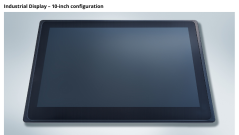
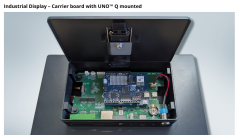
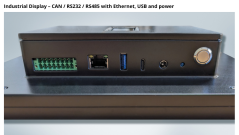
Together with our partner JMO, we have developed our first UNO™ Q offering: an industrial panel in seven- and ten-inch configurations that presents a Linux interface controlled via touchscreen to the user. In addition, it also offers the real-time performance of Zephyr OS running on the STM32 to manage the external industrial interfaces such as CAN, RS485, RS232 and GPIO which customers can use to control machinery connected to the panel.
Industrial Panel and Interfaces
The industrial panel incorporates an UNO™ Q, which is fixed to a carrier board that exposes the MIPI Display, touchscreen interface, and connects the UNO™ Q with industrial interfaces required for a typical industrial application. The industrial panel is shipped with its own SDK running on the Arduino assets, and it is CE-certified and ready to install and use.
Open-Sourced Development Platform
With the launch of Arduino UNO™ Q and their plan to launch Qualcomm Dragonwing™ processor-based solutions, we now have access to an open-sourced development platform that will help us to prototype design concepts and ideas focused on computer vision and Edge AI. Once the prototype has been realized our team at CODICO can leverage our Qualcomm partner ecosystem to offer SOMs, SBCs and edge computers based on Qualcomm Dragonwing™, which are suitable for mass-production projects.
Your Contact Person
Thomas Carmody is available to answer your questions about Arduino UNO™ Q.